Gustavo D. Carvalho
Especialista e mestre em Periodontia; Doutorando em Implantodontia; Professor de Implantodontia
da Faculdade São Leopoldo Mandic – Curitiba – PR.
ORCID:
Antonio Batista
Especialista, mestre e doutor em Endodontia – Unicamp; Professor de Endodontia da Universidade
Federal do Paraná.
ORCID:
DOI: https://doi.org/10.71440/2675-5610.10.2.25.388-390.art
RESUMO
Dentes duplos representam alterações morfológicas raras, classificadas como fusão ou geminação. A fusão ocorre pela união de dois germes dentários durante o desenvolvimento, enquanto a geminação resulta da tentativa de divisão de um único germe dentário. Essas anomalias podem afetar a estética, função
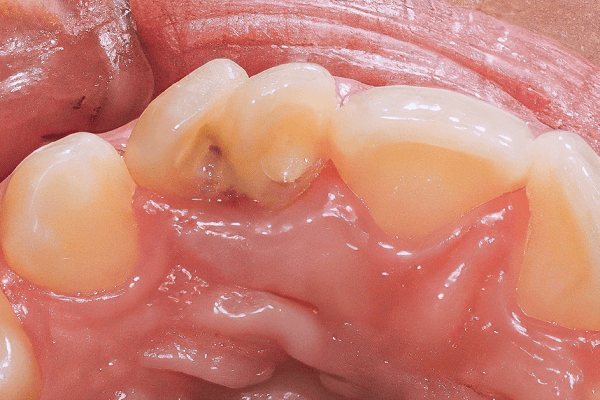
e saúde periodontal, especialmente em região anterior. Este artigo apresenta um caso clínico de uma paciente de 13 anos com dor e fístula na região do dente 12, posteriormente diagnosticado como
incisivo lateral superior fusionado com um dente supranumerário, com envolvimento de coroa e raiz. Mesmo após retratamento endodôntico, a fístula persistiu. Diante da escassez de literatura, optou-se por uma abordagem conservadora com exodontia seletiva do supranumerário e condicionamento radicular do dente remanescente, conduzida por equipe multidisciplinar. O acompanhamento clínico e radiográfico de sete anos demonstrou sucesso funcional e estético, sem recorrência da fístula. O manejo individualizado e conservador mostrou-se eficaz para preservar o dente natural em paciente jovem, postergando a necessidade de reabilitações mais invasivas.
Palavras-chave: Fusão dentária; Dente supranumerário; Anomalia dentária; Adolescente.
Multidisciplinary management of a maxillary lateral incisor fused with a supernumerary tooth in adolescence: a 7 -year follow-up
ABSTRACT
Double teeth represent rare morphological anomalies, classified as fusion or gemination. Fusion results from the union of two tooth germs during development, whereas gemination arises from the attempted division of a single germ. These anomalies may affect aesthetics, function, and periodontal health, particularly in the anterior region. This clinical case reports a 13-year-old female patient presenting with pain and a fistula in the area of tooth 12, which was later diagnosed as a maxillary lateral incisor fused with a supernumerary tooth, involving both crown and root. Despite endodontic retreatment, the fistula persisted. Due to the limited available literature, a conservative approach was chosen: selective extraction of the supernumerary portion and root surface conditioning of the remaining tooth, managed by a multidisciplinary team. Clinical and radiographic follow-up over seven years demonstrated functional and aesthetic success, with no recurrence of the lesion. Individualized, conservative management proved effective in preserving the natural tooth in a young patient, delaying the need for invasive rehabilitation.
Keywords: Tooth Fusion; Supernumerary Tooth; Dental Anomaly; Adolescent.
Referências
1. Aguiló L, Gandía JL, Cibrian R, Catala M. Primary double teeth. A retrospective clinical study of their morphological characteristics and associated anomalies. Int J Paediatr Dent. 1999 Sep;9(3):175-83.
2. Brook AH, Winter GB. Double teeth. A retrospective study of ‘geminated’ and ‘fused’ teeth in children. Br Dent J. 1970 Aug 4;129(3):123-30.
3. Tsesis I, Rosen E, Tamse A, Taschieri S, Kfir A. Diagnosis of vertical root fractures in endodontically treated teeth based on clinical and radiographic indices: a systematic review. J Endod. 2010 Sep;36(9):1455-8.
4. Devanathan K, Somasundaram PR. Management of fused permanent maxillary central incisor: a case report. J Clin Diagn Res. 2016;10(4):ZD06-ZD07.